
Skip to content
  • There are no suggestions because the search field is empty.

Airfreight Export Shipment Types

This article describes the various shipment types available in the Air Freight Export module and their respective functions. In particular, it covers Booking, House and Super-House shipments, Direct shipments, Back-to-Back shipments, as well as Coload Out/Coload In and consolidation shipments.

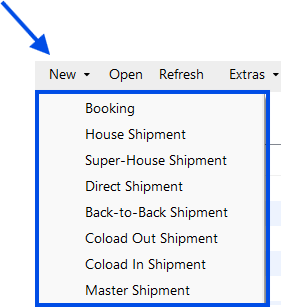
The various shipment types in the Air Freight Export module can be found in Scope as follows:
    • Navigate to Airfreight > Export Shipments
    • In the top menu, click New and then select the desired shipment type
 

Booking

A booking is used for the preliminary entry of a transport that has not yet been fully specified. Only the Customer field is mandatory, allowing the booking to be saved with minimal information.

Within the booking, all relevant data can be entered step by step and subsequently converted into the following shipment types:
  • House
  • Direct
  • Back-to-Back Shipment
  • Master with House
  • Coload Out
  • Coload In 

A Booking is typically created when:

  • it is not yet clear whether, when, or how the shipment will be transported, or
  • not all required data is yet available

House Shipment

The House Shipment is a central shipment type in Air Freight Export and is used to combine individual shipments into a consolidation. Typically, the house shipment is addressed directly from the actual shipper to the final consignee.

In contrast, the Master shipment is addressed by the shipping forwarder (export agent or export gateway) to the receiving forwarder (import agent or import gateway). It combines multiple house shipments into one consolidated shipment.

The airline is involved only at the consolidation level, not at the individual house shipment level.


Super-House Shipment

The Super-House shipment is used to consolidate multiple house shipments with the same consignee. It therefore represents an additional consolidation level within the master consolidation.
 
The individual shipments are initially created as separate house shipments. They can then be consolidated within the super-house shipment under the Consolidation tab as so-called sub-houses. Within the master consolidation, the super-house shipment is then treated as a single house shipment.

The objective is to efficiently consolidate shipments with the same consignee and to make the handling process more transparent and cost-effective.

In practice, the super-house shipment is commonly used when a consignee receives goods from multiple suppliers—for example, from different shippers within Germany—that are to be transported together in a single shipment.


Direct Shipment

A direct shipment describes the transport from the shipper to the consignee without consolidation with other shipments.

Alternatively, the shipment can be addressed to an agent “for the attention of” (notify) a consignee.

In contrast to other shipment types, a direct shipment has only a single Air Waybill (AWB) number, as there is no distinction between house and consolidation shipments.
 
This shipment type is primarily used when:
  • short transit times are required, or
  • the shipment must be handled separately without consolidation 

Back-to-Back Shipment

A back-to-back shipment is a combination of exactly one house shipment and one corresponding master (consolidation) shipment. It is used when a single shipment is to be represented at both the house and master level, without actual consolidation with other shipments.
 
In contrast to a traditional consolidation, a back-to-back structure consists of only one house shipment and one master shipment, which are directly linked to each other.
 
The main purpose of this shipment type is to simplify operational processing within the system. Instead of creating house and master shipments in separate modules, both levels can be managed together within a single interface.
 

This is particularly useful when:

  • only a single shipment is involved,
  • but both a HAWB and an MAWB need to be issued

Coload Out Shipment

A Coload Out Shipment is a house shipment that is handed over to another freight forwarder for onward consolidation. It is used when the local branch does not consolidate the shipment as part of its own consolidation.

The House Air Waybill (HAWB) is issued in-house before the shipment is transferred to an external forwarder, who then takes over the further consolidation and transportation.
 
Unlike standard house shipments, a Coload Out Shipment is not included in an own consolidation.
 
This shipment type is primarily used when:
  • the own cargo volume is insufficient for a specific destination, or
  • it is not possible to form an economically viable consolidation

Coload In Shipment

A Coload In shipment is a house shipment that is received from an external freight forwarder and integrated into the own consolidation.

In this case, the House Air Waybill (HAWB) is issued by the partner forwarder. The shipment is then taken over into the own consolidation and transported together with other shipments.
 
In contrast to a Coload Out shipment, the shipment is incorporated into the own consolidation.

This shipment type is primarily used when:
  • additional shipments are required to complete or improve the utilization of an existing consolidation, or
  • a partner forwarder provides cargo that can be handled via the own transport network

Master Shipment

A Master shipment (consolidation shipment) is used to combine multiple house shipments into a single transport.
 
In this process, the consolidation shipment is addressed by the shipping forwarder (export agent or export gateway) to the receiving forwarder (import agent or import gateway) at the destination. It represents the higher-level transport layer under which multiple individual house shipments are grouped.
 
The objective of the consolidation shipment is to:
  • increase the total volume and/or weight, and
  • thereby achieve more favorable freight rates with the carrier (airline)
As a result, this provides a cost-efficient shipping solution for shippers and consignees, even for smaller individual consignments.